Article of the Month - March 2026
|
Widening Access and Participation in Geomatics
Education:
Insights from Curriculum Transformation at Tshwane University of
Technology, South Africa
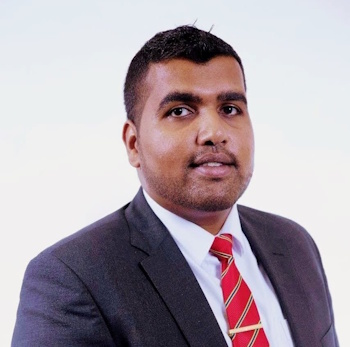
Kovilen Reddy, South Africa
This article in .pdf-format
(16 pages)
SUMMARY
Curriculum reform in professional and technical education is
increasingly shaped by the need to align regulatory requirements with
widening participation and labour market relevance. In South Africa,
this challenge has been particularly pronounced at universities of
technology following the phase-out of legacy National Education and
Training qualifications and the introduction of the Higher Education
Qualifications Sub-Framework. This paper presents a longitudinal case
study of curriculum reform in the Department of Geomatics at the Tshwane
University of Technology between 2018 and 2025, spanning the closure of
legacy programmes and the implementation of a newly articulated
programme and qualification mix.
Drawing on institutional enrolment and graduation data, programme
documentation, professional accreditation records, and surveys of
students, graduates, and employers, the study examines how changes to
qualification structure and progression pathways shaped access,
participation, student progression, and graduate outcomes in geomatics
education. A mixed-methods approach was used to integrate quantitative
trends with qualitative evidence, allowing curriculum reform to be
examined as both a structural and experiential process.
The findings indicate that the transition to an articulated,
outcomes-aligned qualification framework was accompanied by a recovery
in enrolments following an initial period of volatility, shifts in
participation patterns, and strengthened progression across
qualification levels. Student success indicators stabilised as new
programmes matured, while graduate outcomes reflected diverse employment
pathways, entrepreneurial activity, and mobility within and beyond South
Africa. Although grounded in a single institutional context, the case
offers insights relevant to higher education institutions in both
developed and developing settings that are seeking to address enrolment
pressures, widen participation, and sustain professional relevance in
geomatics and related geospatial disciplines.
INTRODUCTION
Professional and technical education in geomatics is shaped by the
interaction between national qualification policy, institutional
practice, and professional regulation. In South Africa, recent
curriculum reform must be understood against the background of an
earlier qualification system that structured surveying and geomatics
education for several decades. Prior to the current framework, geomatics
education at universities of technology was largely offered through
qualifications developed under the National Education and Training
system. These legacy programmes included the National Diploma and
Bachelor of Technology, were widely recognised by employers and
professional bodies, and were strongly practice-oriented, playing a
central role in supplying graduates to both the public and private
sectors.
Despite these strengths, the structure of the legacy system presented
limitations, particularly in relation to articulation and comparability.
Progression between qualification levels was often linear and
institution-specific, offering limited flexibility for re-entry or
movement across institutions. Credit structures and qualification types
differed from internationally recognised degree models, constraining
portability and broader recognition (Council on Higher Education, 2010).
While professional competence was well established, opportunities for
formal vertical progression and lifelong learning were uneven. These
characteristics formed the context within which national qualification
reform was initiated.
South Africa’s reform process began with the introduction of the
Higher Education Qualifications Framework in 2007, which aimed to
standardise qualification types and improve coherence within higher
education (Department of Education, 2007). This framework was
subsequently revised and replaced by the Higher Education Qualifications
Sub-Framework in 2013, which operates as the higher education
sub-framework of the National Qualifications Framework and provides
clearer alignment with locally and internationally comparable
qualification structures (Council on Higher Education, 2013). A
ministerial notice issued in 2016 required all non-aligned legacy
qualifications to be closed to new entrants by the end of 2019, with
institutions responsible for managing pipeline students thereafter
(Department of Higher Education and Training, 2016).
Although national policy defined the parameters of reform,
implementation occurred within a higher education system marked by
persistent inequalities in access and participation, particularly in
technical and professional fields (Council on Higher Education, 2010).
Similar pressures are evident internationally, where institutions are
expected to widen participation, support lifelong learning, and prepare
graduates for rapidly evolving labour markets (Altbach, Reisberg and
Rumbley, 2009; UNESCO, 2021). The transition from legacy qualification
systems to articulated, outcomes-based frameworks, therefore, provides a
lens through which curriculum reform can be examined as both a
regulatory and a social intervention.
This paper examines how the Department of Geomatics at the Tshwane
University of Technology (TUT) responded to the phase-out of legacy
qualifications by restructuring its programme and qualification mix in
line with the national framework. It asks three interrelated questions:
how the redesigned programme qualification mix has affected access and
participation; how it has influenced student success and progression
across qualification levels; and how it has shaped employability and
mobility outcomes for graduates. Drawing on institutional documentation,
enrolment and graduation data, stakeholder surveys, and professional
accreditation feedback, the study analyses curriculum reform as a
mechanism for widening participation while strengthening professional
and labour market alignment.
By situating the case within both national transformation priorities
and international debates on inclusive higher education, the paper
contributes insights relevant beyond the South African context. While
grounded in a single institution, the findings speak to wider challenges
faced by universities seeking to balance regulatory compliance, equity,
and professional relevance in specialised fields such as geomatics
2. METHODS
2.1. Research design and scope
This study adopts a single-institution case study design focused on
the Department of Geomatics at TUT. A case study approach was selected
to enable detailed examination of how national qualification reform was
implemented within a specific disciplinary and institutional context,
rather than to produce statistically generalisable findings (Yin, 2018).
The review period spans 2018 to 2025, covering the phase-out of
legacy National Education and Training qualifications, the introduction
of Higher Education Qualifications Sub-Framework–aligned programmes, and
the early stabilisation of the redesigned programme and qualification
mix. This timeframe captures both transitional disruption and emerging
outcomes following implementation. The Department of Geomatics at TUT
provides a relevant site for examining curriculum reform in professional
education. During the review period, the department transitioned from
legacy qualifications to a vertically articulated suite of diploma,
bachelor, advanced diploma, and postgraduate diploma programmes aligned
with the professional registration requirements of the South African
Geomatics Council (SAGC). While the case is not intended to be
representative of all institutions, it offers analytically grounded
insights into curriculum reform processes that may be relevant to other
professionally oriented disciplines.
2.2 Data sources
Evidence for the study was drawn from four complementary sources to
capture both curriculum reform and student outcomes. Programme and
qualification documentation, including Programme and Qualification Mix
(PQM) records and Programme Quality Management System (PQMS)
documentation, provided information on curriculum design, enrolment
patterns, progression, and throughput across diploma, bachelor, advanced
diploma, and postgraduate diploma programmes. This material included
self-evaluation reports prepared for professional accreditation visits
and institutional responses to national quality assurance requirements.
Feedback from external regulatory and professional bodies, including
the Council on Higher Education (CHE), the Department of Higher
Education and Training (DHET), and the SAGC, confirmed programme
alignment, compliance, and quality, and contextualised challenges
encountered during initial development and early implementation.
Institutional enrolment, retention, and graduation data were drawn from
the Higher Education Management Information System (HEMIS) and internal
university records to support longitudinal analysis of access,
participation, and completion trends, including disaggregation by
selected demographic indicators. Qualitative evidence from student and
graduate surveys, employer feedback, and work-integrated learning (WIL)
reports provided insight into the student experience, programme
relevance, employability, and alignment with labour-market needs.
Table 1 summarises the data sources.
| Data
Source |
Type
of Evidence |
Relevance to the Study |
|
Programme and qualification documentation
|
Programme approval
records, self-evaluation reports, enrolment and progression
statistics |
Provides evidence of curriculum design, implementation, and
student outcomes |
|
Accreditation and regulatory documents
|
Professional accreditation
reports and national quality assurance documentation |
Confirms compliance, quality and alignment with policy and
professional requirements. |
|
Institutional enrolment and graduation
data
|
Institutional statistics on enrolment, retention and completion
statistics |
Enables
longitudinal tracking and analysis of access, retention and
success across demographic groups over time. |
|
Stakeholder feedback
|
Student
and graduate surveys, employer feedback, student experience, and
WIL reports |
Provides insight into programme relevance, employability and
labour market alignment |
2.3 Analytical approach and research phases
A mixed-methods approach was used to analyse the evidence generated
across the review period. Quantitative enrolment, retention, and
graduation data were analysed descriptively to identify longitudinal
patterns in access, participation, and completion during the transition
from legacy to Higher Education Qualifications Sub-Framework–aligned
programmes. Qualitative material from programme documentation,
accreditation feedback, surveys, and work-integrated learning reports
was analysed thematically to examine experiences of curriculum
implementation, student progression, and employability. Findings from
the different data sources were integrated through triangulation to
strengthen analytical coherence and to link institutional, regulatory,
and stakeholder perspectives. The sequence and integration of analytical
steps are illustrated in Figure 1.

Figure 1. Phased integration of
quantitative and qualitative evidence used in the study
3. RESULTS
This section presents the outcomes of the Department of Geomatics'
curriculum reform at TUT between 2018 and 2025. The results are
organised thematically to describe changes in programme structure,
enrolment patterns, access and participation, student success,
articulation across qualification levels, and graduate employability and
mobility. Findings are reported descriptively, with reference to figures
and tables, and focus on observed patterns and trends in the data.
Interpretation of these results and their broader implications is
addressed in the discussion section.
3.1 Programme reform and transition
The department renewed its programme and qualification mix in
response to the national phase-out of legacy National Education and
Training qualifications, which began in 2019. The National Diploma
Surveying (NDSU03) and the Bachelor of Technology in Surveying (BTSU18)
were progressively closed, while new qualifications aligned to the
Higher Education Qualifications Sub-Framework were introduced
incrementally. These included the Bachelor of Geomatics (BPGM20) in
2020, followed by the Diploma in Geomatics (DPGM23) and Advanced Diploma
in Geomatics (ADGM23) in 2023, and the Postgraduate Diploma in Geomatics
(PDGM24) in 2024. Together, these programmes form a vertically
articulated structure that enables progression from diploma to
postgraduate level, aligned with the registration requirements of the
South African Geomatics Council (SAGC, 2023; 2024a; 2024b). The SAGC
endorsed all new qualifications for registration at technician,
technologist, and professional levels, subject to conditions linked to
early implementation challenges that were addressed as the programmes
matured.
In addition to programme replacement, alternative entry and
progression routes were incorporated into the new qualification
structure. Recognition of prior learning and articulation from Technical
and Vocational Education and Training colleges were embedded in
admission requirements for the new programmes. Block-mode delivery at
higher qualification levels was also introduced, enabling participation
by working professionals. Figure 2 presents the restructured programme
and qualification mix, illustrating articulation pathways across the
National Qualifications Framework.
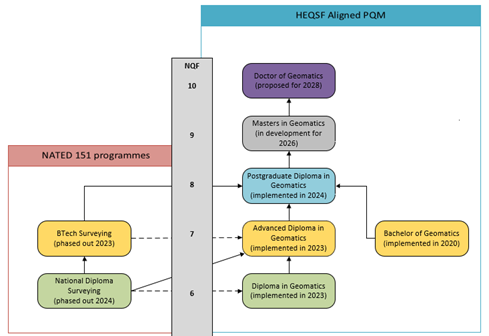
Figure 2. Restructured programme and
qualification mix showing articulation pathways across National
Qualifications Framework levels
3.2 Access and participation
The transition from legacy National Education and Training
qualifications coincided with short-term volatility in student
enrolments. Enrolments in the National Diploma Surveying increased
sharply in 2019 as prospective students sought entry before programme
closure, followed by a steady decline as pipeline students completed
their studies. A similar tapering pattern was observed in the BTech
Surveying, which closed at the end of 2023. This resulted in a temporary
gap before enrolments were absorbed into the new Higher Education
Qualifications Sub-Framework–aligned programmes.
The Bachelor of Geomatics, introduced in 2020, initially enrolled
small cohorts and experienced disruption during the COVID-19 pandemic,
before growing steadily to more than 200 students by 2025. The Diploma
and Advanced Diploma in Geomatics, introduced in 2023, reached
enrolments of over 250 and 80 students, respectively, within two years,
while the Postgraduate Diploma in Geomatics doubled its intake in its
first two years. Total enrolments reached a transitional low in 2022
before recovering strongly to nearly 600 students by 2025 (Figure 3).
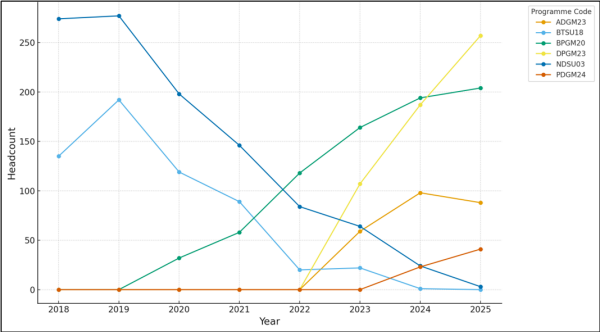
Figure 3. Total enrolments in geomatics
programmes, 2018–2025
First-time entrant data further illustrate shifts in demand for
entry-level qualifications. As shown in Table 2, enrolment moved from
the legacy diploma to the new diploma and bachelor pathways as the
restructured programme mix matured, reflecting both progression of
existing cohorts and sustained new intakes.
Table 2. First-time entrants to entry-level
programmes during the transition to HEQSF
| Programme |
2018 |
2019 |
2020 |
2021 |
2022 |
2023 |
2024 |
2025 |
| BPGM20 |
- |
- |
37 |
38 |
75 |
74 |
74 |
73 |
| DPGM23 |
- |
- |
- |
- |
- |
113 |
108 |
105 |
| NDSU03 |
83 |
96 |
0 |
0 |
0 |
0 |
0 |
0 |
| Total |
83 |
96 |
37 |
38 |
75 |
187 |
182 |
178 |
Participation patterns also changed demographically over the review
period. Female representation increased from approximately one-quarter
of enrolments in 2018 to 44 percent by 2025, while the proportion of
students from Quintile 1–3 schools increased from under 10 percent to
nearly 40 percent (Figure 4). In the South African schooling system,
public schools are classified into quintiles from 1 to 5, with Quintile
1 representing the poorest communities and Quintile 5 the most affluent;
growth in enrolments in Quintiles 1–3 therefore indicates expanded
participation by students from historically disadvantaged educational
backgrounds.
These shifts coincided with a range of access-related initiatives
implemented during the review period, including outreach to
under-resourced schools, dissemination of information on financial aid
through the National Student Financial Aid Scheme, and supplementary
academic support in mathematics and physical sciences for prospective
students. Student-led initiatives, particularly through the TUT
Geomatics Student Society, further extended outreach by enabling
enrolled students to share information within their home communities.
Although not presented here, geocoded analysis of student home addresses
showed a widening spatial distribution of enrolments following the
introduction of the redesigned programme and qualification mix. By 2025,
almost 95 percent of enrolled students identified as black African,
reflecting broader national demographic patterns in public higher
education, with the remaining enrolments drawn from white, Indian, and
coloured students. The implications of this demographic profile are
considered further in the discussion section.
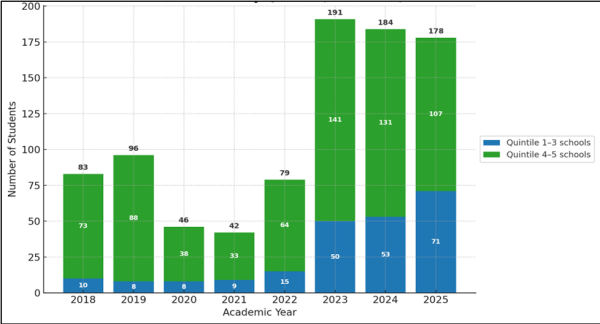
Figure 4. Quintile changes, 2018-2025,
signalling expanded access for disadvantaged groups
Alternative access routes became increasingly prominent. Students
entered through recognition of prior learning assessments and
articulation from Technical and Vocational Education and Training
colleges, pathways that were formally incorporated into admission
requirements for the new programmes. As illustrated in Figure 5, these
routes expanded over time and contributed to participation by
non-traditional students.
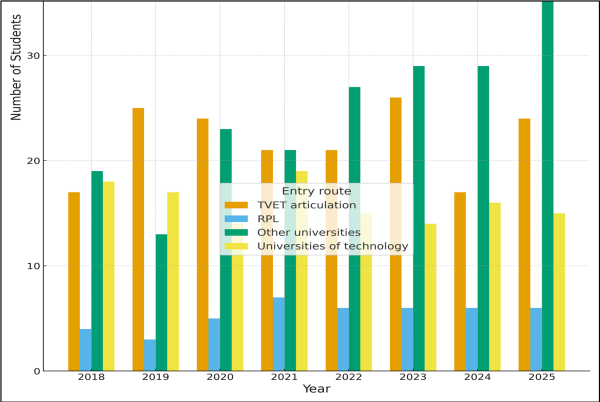
Figure 5. Alternative entry routes into
geomatics programmes
3.3 Student success
Student success outcomes varied across qualifications and over time,
reflecting both programme transition and system-wide disruption during
the COVID-19 pandemic. Pass rates in the legacy National Diploma in
Surveying were stable at around 70 percent before 2020, declined during
the pandemic period, and recovered in the final years before programme
closure in 2024. The Bachelor of Geomatics, introduced in 2020, recorded
lower pass rates in its early cohorts, reaching the mid-50s in 2021
before stabilising at approximately 74 percent as the programme matured.
The Diploma in Geomatics achieved pass rates between 70 and 75 percent
in its initial years. In comparison, the Advanced Diploma in Geomatics
improved from 67 percent in its first year of delivery to 74 percent in
the second. The Postgraduate Diploma in Geomatics recorded an 87 percent
pass rate in its inaugural 2024 cohort. These patterns are summarised in
Figure 6.
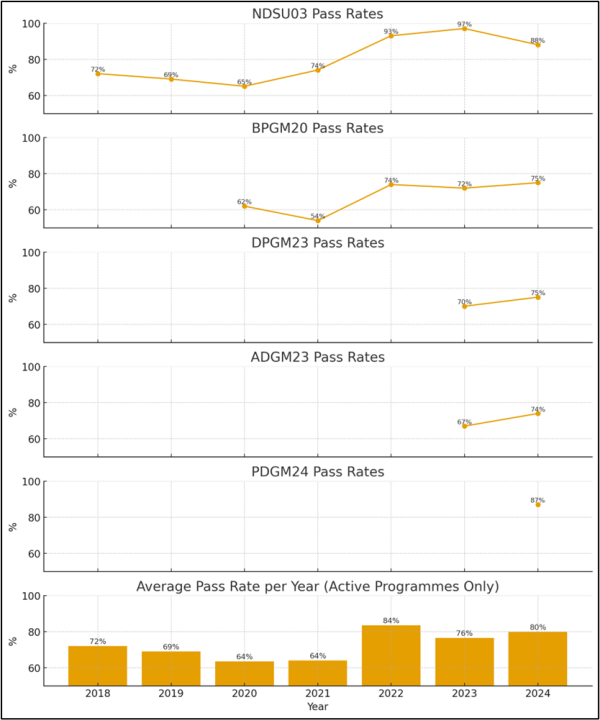
Figure 6. Pass rates by qualification,
2018–2025
Retention rates remained relatively high across the review period,
generally ranging between 80 and 90 percent, with temporary declines
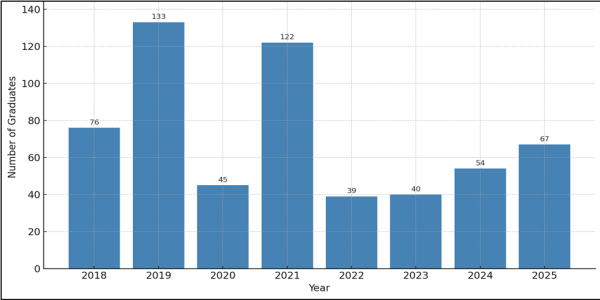
during the pandemic and recovery from 2022 onwards. Graduation patterns
reflected both extended time to completion and the phased closure of
legacy qualifications, with many students in undergraduate 3-year
programmes requiring four years to complete qualifications. As
illustrated in Figure 7, graduation numbers declined during the
transition period and increased from 2023 as cohorts from the new Higher
Education Qualifications Sub-Framework–aligned programmes reached
completion. Peaks in graduation in 2019 and 2021 corresponded with
accelerated module offerings to support completion of legacy programmes
prior to closure.
3.4 Articulation
Patterns of student progression across qualifications show that
articulation occurred across the programme suite during the review
period. Recorded flows include progression within the legacy programmes
prior to their phase-out from 2019, as well as movement into newly
introduced Higher Education Qualifications Sub-Framework–aligned
programmes, particularly the Advanced Diploma in Geomatics. Progression
from the Bachelor of Geomatics into the Postgraduate Diploma in
Geomatics was also observed (Figure 8). The data further show instances
of students re-entering formal study after breaks in enrolment and
moving between qualification levels at different points in time. Such
movements occurred across both legacy and new programmes, indicating
multiple entry and exit points and reflecting vertical progression from
entry-level to postgraduate qualifications alongside re-entry following
interrupted study trajectories
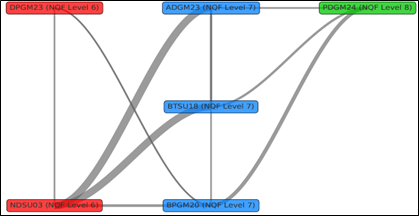
Figure 8. Sankey Chart showing articulation
flows across geomatics qualifications
3.5 Employability and mobility
A graduate survey conducted with all graduates since 2018 received
272 responses from a total of 576 graduates, noting that many
respondents had articulated through more than one qualification.
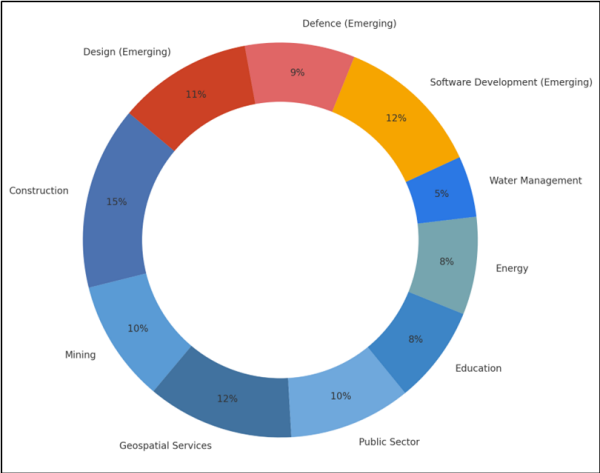
Employment outcomes were reported across a wide range of sectors,
including construction, mining, geospatial services, the public sector,
education, energy, and water management. Nearly 30 percent of
respondents reported employment in emerging fields such as software
development, defence, and design.
Entrepreneurial activity was also reported. Seventeen percent of
respondents indicated that they had established single or joint
practices within three years of graduation, in some cases employing
other graduates from the department. In addition, a proportion of
graduates reported pursuing further study, either within the institution
or at other higher education institutions. Graduate mobility extended
beyond the national labour market. Respondents reported using their
qualifications to secure employment elsewhere in Africa and
internationally, including in the Middle East, Australia, New Zealand,
the United Kingdom, North America, and the Nordic region. The sectoral
distribution is summarised in Figure 9.
3.6 Summary of results
The results indicate that the transition from legacy qualifications
to a restructured, Higher Education Qualifications Sub-Framework–aligned
programme and qualification mix gradually coincided with changes in
enrolment patterns, participation, student success, and graduate
outcomes over the review period. Following an initial phase of
volatility during the transition period, enrolments recovered as new
programmes became established. Participation broadened demographically,
while articulation and progression across qualification levels were
observed, including re-entry following interrupted study. Student
success indicators stabilised as programmes matured, and graduate
outcomes reflected a range of employment pathways, entrepreneurial
activity, and mobility within and beyond South Africa.
4. DISCUSSION
The findings presented in the preceding section are considered here
in relation to curriculum reform and professional education in
geomatics. The discussion situates the case of the Tshwane University of
Technology within broader national and international debates on widening
access, articulated learning pathways, and workforce development in
technically specialised fields. The transition to Higher Education
Qualifications Sub-Framework–aligned programmes is examined not only as
a regulatory response, but also as a process that reshaped access
routes, progression opportunities, and graduate trajectories over time.
In doing so, the discussion engages with international priorities around
inclusive and equitable higher education, including Sustainable
Development Goal 4 (quality education) and Sustainable Development Goal
10 (reduced inequalities), while remaining attentive to the
institutional and policy context in which the reform occurred.
4.1. Curriculum reform and widening access
The findings indicate curriculum reform in geomatics education was
associated with measurable shifts in access and participation during the
review period, particularly in relation to gender and socio-economic
background. Increases in female enrolment and participation by students
from Quintile 1–3 schools suggest that the restructured programme and
qualification mix coincided with broader entry into a field that has
historically shown limited demographic diversity. In the South African
context, where school quintiles serve as a proxy for socio-economic
disadvantage, these patterns align with national transformation
priorities as well as international commitments under Sustainable
Development Goals 4 and 10, which emphasise inclusive and equitable
access to education. While the results do not support causal
attribution, the consistency of these trends points to the role of
qualification structure, formal articulation pathways, and alternative
access routes in shaping participation. Flexible modes of delivery also
appear to have played a role, particularly through the introduction of
block-mode provision in advanced and postgraduate programmes, which
expanded access for working professionals seeking to continue their
studies beyond undergraduate level and to register at higher
registration categories of the South African Geomatics Council. At the
same time, the findings suggest that curriculum reform alone is
insufficient to widen participation, and that sustained gains depend on
complementary institutional measures identified in the results,
including targeted outreach, financial aid awareness, and academic
support in professional fields with high entry thresholds.
4.2. Articulation, progression and lifelong learning
The results demonstrate that the restructured programme and
qualification mix enabled more flexible patterns of articulation and
progression than were possible under the legacy qualification system.
Observed movement across qualification levels, including progression
from entry-level to postgraduate study and re-entry following
interrupted enrolment, indicates that formal articulation pathways
functioned in practice rather than existing only as structural design
features. These patterns align with broader shifts in professional
higher education towards supporting lifelong learning, where study
trajectories are increasingly shaped by employment, financial
constraints, and changing skills requirements. In the South African
context, where historical inequalities have constrained upward mobility,
the availability of multiple entry and exit points represents an
important mechanism for extending educational opportunity over time.
More broadly, the findings suggest that articulation within a coherent
qualification framework can support progression for both traditional and
non-traditional students, while maintaining alignment with professional
registration requirements in a regulated field such as geomatics.
4.3. Student success and progression
Patterns of student success observed during the review period reflect
the combined effects of curriculum reform, programme maturation, and
system-level disruption. Variability in pass rates across
qualifications, particularly during early implementation and the
COVID-19 pandemic, highlights the sensitivity of student performance to
periods of structural change. The subsequent stabilisation of pass rates
as programmes became established suggests that student success is
closely linked to the consolidation of curriculum design, assessment
practices, and academic support. Extended time to completion and
staggered graduation patterns further indicate that success in
professional education cannot be assessed solely against nominal
programme durations. Instead, continuity of study and eventual
completion emerge as meaningful indicators of success within an
articulated qualification framework that accommodates non-linear
progression and diverse student trajectories.
4.4. Graduate outcomes, mobility and labour market alignment
Graduate outcomes reported in this study indicate that the
restructured qualification framework supported employability across a
diverse and evolving labour market. Employment across both traditional
geomatics sectors and emerging geospatial fields suggests that
curriculum reform facilitated the development of adaptable and
transferable skills rather than narrowly defined occupational
preparation. Entrepreneurial activity among graduates further reflects
forms of professional formation that extend beyond salaried employment.
Graduate mobility within and beyond South Africa points to improved
comparability and recognition of qualifications aligned to the Higher
Education Qualifications Sub-Framework, while also highlighting ongoing
tensions between global employability and local skills needs. Within
this context, the findings underscore the role of curriculum reform in
supporting professional formation that is responsive to both national
development priorities and participation in international labour
markets.
4.5. Remaining challenges and opportunities
While the findings point to positive outcomes associated with
curriculum reform, several challenges remain. Sustaining growth in
access and participation will require continued investment in academic
staffing and administrative capacity, alongside targeted academic
support to consolidate gains. Representation of smaller population
groups remains limited, indicating the need for more nuanced inclusion
strategies beyond initial access. In addition, stronger and more
systematic partnerships with industry will be important to sustain
graduate opportunities across both established and emerging sectors,
particularly in an evolving geospatial labour market. These challenges
highlight that curriculum reform is not a one-off intervention but an
ongoing process that depends on institutional capacity, external
engagement, and responsiveness to changing professional contexts.
5. CONCLUDING REMARKS AND RECOMMENDATIONS
This paper examined curriculum reform in geomatics education through
a longitudinal case study of the Department of Geomatics at the Tshwane
University of Technology during the transition from legacy National
Education and Training qualifications to Higher Education Qualifications
Sub-Framework–aligned programmes. The findings show that restructuring
the programme and qualification mix was accompanied by changes in
enrolment patterns, participation, student progression, and graduate
outcomes over time. Following an initial period of volatility associated
with programme closure and system-level disruption, enrolments recovered
as new programmes became established, participation broadened
demographically, and articulation across qualification levels was
observed in practice. Student success indicators stabilised as
programmes matured, while graduate outcomes reflected diverse employment
pathways, entrepreneurial activity, and mobility within and beyond South
Africa.
While grounded in a single institutional context, the case offers
insights relevant to higher education institutions in both developing
and developed settings where geomatics and related geospatial fields
compete with other STEM disciplines for student enrolment and
visibility, despite their foundational role in infrastructure
development, environmental management, digital transformation, and
spatial decision-making. Across contexts, the findings suggest that
clearly articulated qualification pathways, flexible entry and exit
points, and delivery modes that accommodate working professionals can
support participation and progression across diverse student
populations. At the same time, curriculum reform alone is insufficient
to sustain these outcomes without complementary institutional measures,
including adequate staffing, targeted academic support, and sustained
engagement with industry and professional bodies. In this way,
curriculum reform can contribute not only to widening participation and
professional formation, but also to strengthening the visibility and
long-term sustainability of geomatics education within increasingly
competitive higher education environments.
REFERENCES:
-
Altbach, P.G., Reisberg, L. and Rumbley, L.E., 2009. Trends in
global higher education: Tracking an academic revolution. Paris:
UNESCO. Available at:
https://unesdoc.unesco.org/ark:/48223/pf0000183168. [Accessed 22
May 2025].
-
Council on Higher Education (CHE), 2010. Higher Education
Monitor 9: Access and throughput in South African higher education.
Pretoria.
-
Council on Higher Education (CHE), 2013. The Higher Education
Qualifications Sub-Framework. Pretoria.
-
Department of Education and Training, 2007. The Higher Education
Qualifications Framework. Government Gazette No. 30353, 5 October.
Pretoria: Government Printers.
-
Department of Higher Education and Training (DHET), 2016. Notice
1380 of 2016: Phasing out of non-aligned qualifications. Government
Gazette No. 40407, 4 November. Pretoria: Government Printers.
-
South African Geomatics Council (SAGC), 2023. Accreditation
report: Bachelor of Geomatics (BPGM20). Johannesburg: South African
Geomatics Council.
-
South African Geomatics Council (SAGC), 2024a. Accreditation
report: Advanced Diploma in Geomatics (ADGM23). Johannesburg: South
African Geomatics Council.
-
South African Geomatics Council (SAGC), 2024b. Accreditation
report: Postgraduate Diploma in Geomatics (PDGM24). Johannesburg:
South African Geomatics Council.
-
Tshwane University of Technology (TUT), 2018–2025. Internal
records: Self-Evaluation Reports, Programme and Qualification Mix
documents, and HEMIS enrolment and graduation data. Pretoria:
Faculty of Engineering and the Built Environment, Tshwane University
of Technology.
-
United Nations, 2015. Transforming our world: The 2030 Agenda for
Sustainable Development. New York: United Nations. Available at:
https://sdgs.un.org/2030agenda
[Accessed 14 August 2025].
-
United Nations Educational, Scientific and Cultural Organization
(UNESCO), 2021. Reimagining our futures together: A new social
contract for education. Paris: UNESCO. Available at:
https://unesdoc.unesco.org/ark:/48223/pf0000379707 [Accessed 20
June 2025].
-
Yin, R.K., 2018. Case study research and applications: Design and
methods. 6th ed. Thousand Oaks, CA: Sage Publications.
BIOGRAPHICAL NOTES
Kovilen Reddy is Head of the Department of Geomatics in the Faculty
of Engineering and the Built Environment at the Tshwane University of
Technology, Pretoria, South Africa. He is a registered
Professional Land Surveyor with the South African Geomatics Council and
has more than seventeen years of combined industry and academic
experience, including service at the Surveyor General’s Office in
Pretoria and a decade in academia. He holds BSc and MSc degrees in Land
Surveying from the University of KwaZulu-Natal and is currently pursuing
a PhD in marine cadastre. His research and professional interests
include geomatics education, marine cadastral systems, GeoAI, land
administration, curriculum reform, and the application of emerging
technologies in the geospatial professions.
CONTACTS
Mr Kovilen Reddy
Tshwane University of Technology
Faculty of Engineering and the Built Environment
Staatsartillerie Road, Pretoria West, Pretoria, South Africa
Website: https://www.tut.ac.za/


























